
Watershed Monitoring
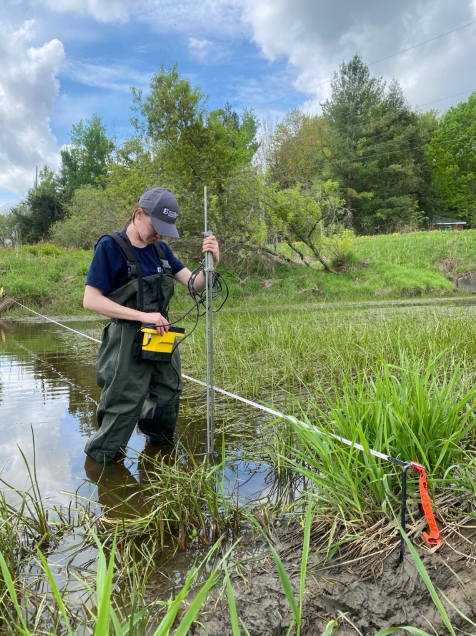
Healthy rivers, headwaters, and species in our watershed are key elements of SNC's strategic business plan.
The ability to track and report on changes to these indicators of clean water supply is paramount to continuing the success of our unique history of watershed planning, management and reporting in Eastern Ontario.
The scope of our science-based monitoring programs focus on key components of land and water ecosystems including: surface and groundwater; native, invasive and at-risk species; stream assessments; and municipal drains.
SNC fish ecology experts provide local knowledge of the 72 fish species that live in the South Nation River system. We assess fish populations and communities in water by using a variety of sampling gears and methods. Fish are temporarily captured using hoop and seine nets; backpack electro-fishing devices; and minnow traps
The overall health of the South Nation watershed is carefully monitored and reported by SNC, using fish as one indicator. The Near Shore Community Index Netting (NSCIN) monitoring program, for example, supplies baseline data that provides insight into population dynamics and species variety, abundance, and health within the six reaches of the South Nation River. The reaches are defined at water control structures located on the main stem of the river. Typically, we sample one reach per year.
An in-depth Fish Population Analysis is available that summarizes SNC’s first 10 years of fish sampling data. The report can be requested by contacting info@nation.on.ca
Learn about the 72 fish species in the South Nation River here
Find out more about SNC's fisheries monitoring along the South Nation River by selecting one of the reports listed below.
- Plantagenet Reach - 2017
- St. Albert Reach - 2016
- Hyndman (Chesterville) Reach - 2015
- Lemieux Reach - 2014
- Spencerville Reach - 2013
This link opens in a new windo
The summer of 2017 marked the last year of SNC’s hoop netting efforts. With over two years of data captured for each of the reaches of the South Nation River, SNC is now working towards filling knowledge gaps in areas where hoop netting would not be feasible. These efforts include electrofishing, fyke netting and seine netting in smaller and shallower areas of the watershed.